
Ever had a visitor on your site, seconds away from leaving, only to be won back by the perfect offer? That’s the power of a well-executed exit intent popup. It’s your last, best chance to convert a visitor before they click away for good. This guide provides actionable steps to turn those departing visitors into customers, subscribers, and valuable sources of feedback.
What Is An Exit Intent Popup And How Does It Work
An exit intent popup is a smart marketing tool that detects when a user is about to leave your website and presents them with a targeted message. This isn’t just another popup; it’s a strategic final touchpoint.
The technology behind it is straightforward. On desktop, it tracks mouse velocity and direction. When a user’s cursor moves rapidly towards the top of the browser—aiming for the close button, a new tab, or the back button—the software triggers the popup. On mobile, it relies on behaviors like rapid scrolling up or hitting the back button.
The Magic Is In The Timing
The effectiveness of an exit intent popup lies in its timing. It appears at the exact moment a visitor disengages, creating a final opportunity to re-engage them. Instead of interrupting their browsing, it acts as a helpful last-ditch effort.
Here are three actionable ways you can use this moment to your advantage:
- Save a sale: Implement a popup on your checkout page that offers free shipping or a 10% discount to users abandoning their cart. This directly addresses one of the top reasons for cart abandonment.
- Grow your email list: On a blog post, offer a relevant resource like a downloadable checklist or an exclusive video in exchange for an email. This captures high-intent leads.
- Get priceless feedback: Trigger a one-question survey on your pricing or cancellation page asking why a visitor is leaving. Use this data to improve your offerings.
Actionable Tip: Frame your popup offer as a helpful solution to a problem. A discount on the checkout page solves a price hesitation; a checklist on a blog post provides a next step. This shifts the perception from an ad to a helpful suggestion.
For a quick overview, here’s a look at the essentials.
Exit Intent Popup At A Glance
| Aspect | Description | Key Metric |
|---|---|---|
| Concept | A popup triggered when a user shows intent to leave a website. | Visitor Abandonment Rate |
| Goal | To re-engage the visitor with a relevant offer and prevent them from leaving. | Conversion Rate |
| Performance | Can recover 10-15% of visitors who would have otherwise left for good. | Leads Captured / Sales Recovered |
This simple tool has become a go-to for marketers for a good reason—it works.
Proven Performance And Potential
Exit intent popups have been a staple in conversion optimization since they first gained traction around 2012. Why? Because the numbers don’t lie. On average, they can bring back 10-15% of abandoning visitors.
While a solid baseline conversion rate for these popups is around 3.09%, the best ones do much, much better. Highly targeted campaigns with compelling offers can see conversion rates soar to 15-25% or even higher. It all comes down to presenting the right offer to the right person. Someone leaving a product page might love a discount, while a visitor leaving a blog post might prefer a related ebook.
To dive deeper into the tactics that drive these results, exploring expert guides on Exit Intent Popup Strategies is a great next step. This approach is all about turning a potential loss into a happy new customer or a valuable lead for the future.
So, What Can Exit Popups Actually Do For You?
Let’s move from theory to practical application. A smart exit intent popup is your last line of defense against lost revenue and missed opportunities. It’s a proactive tool that can solve some of the most persistent challenges for online businesses, like cart abandonment and low lead capture rates.
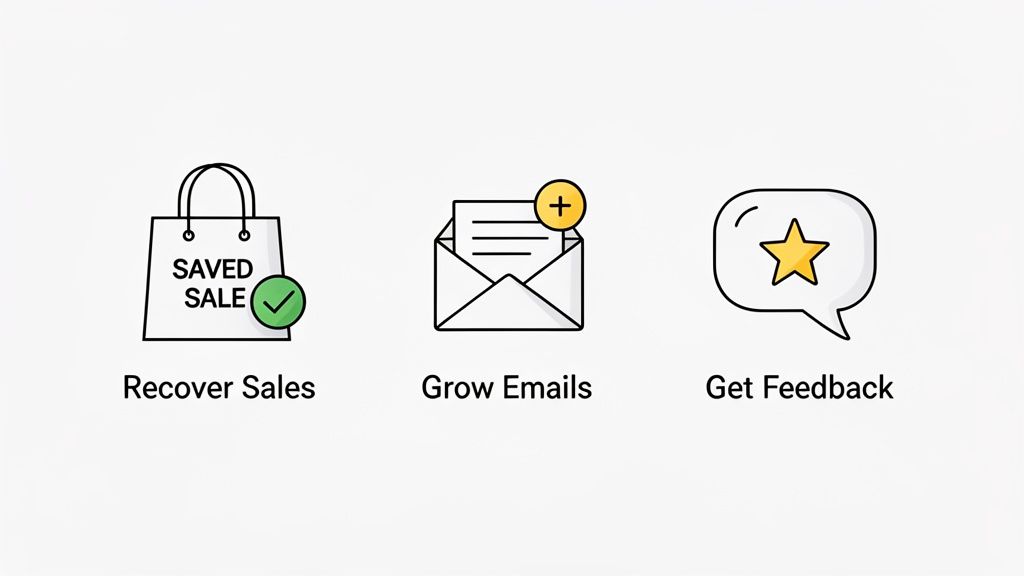
When implemented correctly, exit popups deliver tangible results. Here are the three primary actions you can drive with them.
Recover Sales You Would Have Lost
This is the most direct and financially rewarding use of an exit popup. Every visitor who leaves with items in their cart represents lost revenue. An exit popup is your final opportunity to intervene.
Actionable Insight: Unexpected shipping costs are the #1 reason for cart abandonment. Set up an exit popup that triggers exclusively on your checkout page when a user tries to leave. The offer? “Wait! Get Free Shipping On This Order.” This directly counters their objection and can instantly save the sale.
For SaaS companies, the same logic applies. If a user hesitates on your pricing page, a well-timed popup offering a 14-day extended trial or a free one-on-one demo can provide the reassurance they need to convert.
Grow Your Email List (With People Who Actually Care)
Building a quality email list means attracting subscribers who are genuinely interested in your content. Exit popups excel at this by capturing leads at their peak moment of engagement.
Actionable Insight: Identify your most popular blog posts. On these pages, set up an exit popup that offers a “content upgrade”—a resource that complements the article. For instance, if the article is about “10 Time-Saving Tips,” offer a “Free Productivity Checklist.” This targeted approach yields higher-quality subscribers than a generic “Join our newsletter” form.
By matching your offer to what the visitor was just doing, you attract subscribers who are genuinely invested in your topic. This naturally leads to better open rates, more clicks, and an email strategy that actually works.
The numbers don’t lie. In the tough worlds of ecommerce and SaaS, exit-intent popups used for cart abandonment see an average conversion rate of 17.12%. That blows most general popups out of the water and proves their power to not just grab an email, but to save a sale. You can check out more data on popup performance to see how these stats compare.
Get Honest Feedback You Can Actually Use
One of the most powerful—and often overlooked—uses for exit popups is gathering unfiltered customer feedback. By understanding why people leave, you get an actionable roadmap for improving your website and product.
Here’s how to implement it:
- For Ecommerce: On the cart page, trigger a one-question survey for abandoning visitors: “What’s stopping you from buying today?” with options like “Price,” “Shipping Costs,” or “Trust Concerns.” Use these answers to prioritize site improvements.
- For SaaS: On the subscription cancellation page, use an exit survey: “What could we do differently to convince you to stay?” This feedback is invaluable for reducing churn and guiding your product development.
This strategy transforms a negative event (a user leaving) into a positive learning opportunity. You get a final chance to win them back and collect data to improve the experience for all future visitors.
Creative Exit Intent Popup Examples That Actually Convert
A generic “Join Our Newsletter” popup is a wasted opportunity. To be effective, an exit intent popup must present an offer so relevant it stops the visitor in their tracks. The best popups are tailored to a specific goal: saving a sale, capturing a lead, or gathering feedback.
Here are three actionable strategies, broken down by objective, that you can implement on your site today.
Goal 1: Close The Sale With A Strategic Incentive
For an ecommerce store, every abandoned cart is a direct hit to the bottom line. Instead of a generic coupon, create a targeted offer that feels both personal and urgent.
Actionable Insight: Target first-time visitors who abandon a cart over a specific value (e.g., $75). When they move to exit, trigger a popup with this message: “Wait! As a new customer, take 15% OFF your first order. Complete your purchase now.” This tactic works by:
- Personalizing the offer (“As a new customer”).
- Incentivizing a higher order value.
- Creating urgency to complete the purchase immediately.
You’re doing more than just offering a coupon. You’re giving them a specific, compelling reason to overcome their last-second hesitation and validating their decision to shop with you.
Goal 2: Generate Leads With An Irresistible Resource
For SaaS and content-driven sites, lead generation is paramount. Don’t just ask for an email—earn it by offering something of tangible value that directly relates to the content they’re leaving.
Actionable Insight: A visitor just read your guide on team productivity. As they move to exit, offer a “Free Productivity Cheatsheet.” It’s a logical next step, not an interruption.
The most effective lead magnets are practical tools users can apply immediately:
- Checklists or templates that help them put your advice into action.
- Exclusive video guides that go deeper than the blog post.
- Free calculators or diagnostic tools that solve a specific problem.
With this tactic, you’re not just getting an email. You’re turning a casual reader into a qualified lead who sees you as a valuable expert.
Goal 3: Guide Users And Gather Feedback
Sometimes, the best offer is an offer of help. This strategy is perfect for complex product pages, pricing tables, or SaaS cancellation flows. The goal is to start a conversation and resolve friction.
Actionable Insight: On your pricing page, if a user spends more than 60 seconds and then tries to leave, trigger a popup that asks, “Have questions about our plans? Chat with an expert now.” This simple question can initiate a conversation that leads directly to a sale.
Another powerful tactic is the conditional exit survey. On the subscription cancellation page, ask: “What’s the main reason you’re canceling?” If the user selects “It’s too expensive,” you can instantly present a follow-up offer: “How about 30% off for 3 months?”
Exit Intent Use Case By Business Goal
To make this crystal clear, here’s a breakdown of how different goals translate into practical use cases for both ecommerce and SaaS, and how you could set them up with a tool like Receiver.
| Business Goal | Ecommerce Use Case | SaaS Use Case | Receiver Implementation |
|---|---|---|---|
| Close Sales | Offer free shipping or a 10% discount to users abandoning a high-value cart. | Provide a limited-time discount on an annual plan for users leaving the pricing page. | Trigger a smart incentive based on cart contents or time spent on the pricing page. |
| Generate Leads | Offer a "Style Guide" PDF to visitors leaving a fashion category page. | Offer a free setup checklist to users leaving a "Getting Started" guide or help document. | Use a targeted survey to offer a downloadable asset based on the visitor’s browsing history. |
| Guide Users | Show a "Find Your Perfect Fit" quiz popup on product pages with high bounce rates. | Ask a one-question survey on the cancellation page to understand churn reasons. | Deploy SurveyPilot to ask "Why are you leaving?" and offer a retention incentive. |
By aligning your exit intent popup with a clear business goal and the visitor’s specific context, you stop being intrusive and start being helpful. This simple shift turns a moment of potential loss into a massive opportunity for conversion and connection.
Actionable Best Practices For Timing And Targeting
The difference between a high-converting exit intent popup and an annoying one comes down to context. Smart timing and targeting make your offer feel like a helpful suggestion rather than a disruptive ad. This is how you convert abandoning visitors into customers.
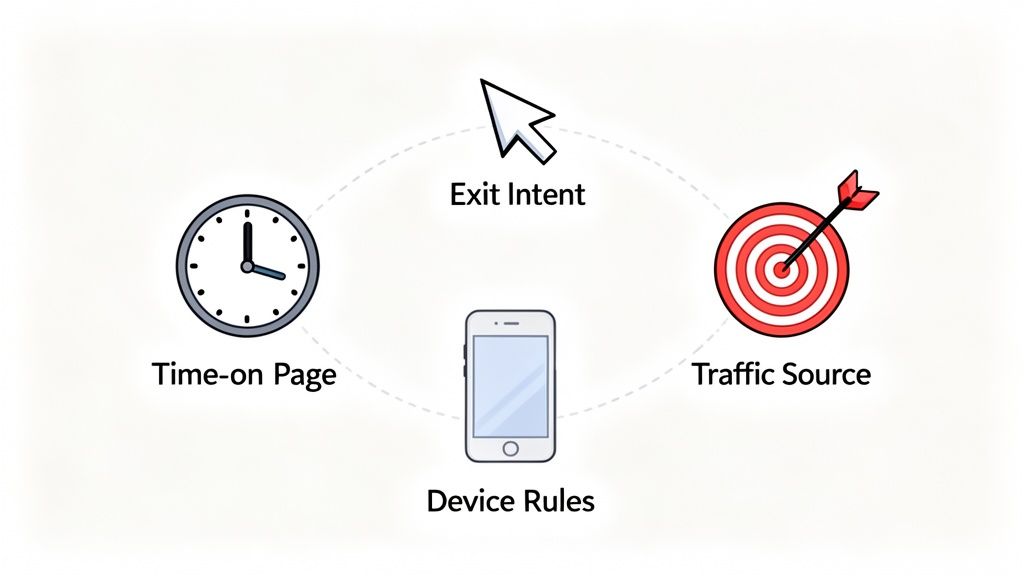
Here are actionable rules you can apply to make your popups smarter and more effective.
Start With Page-Specific Offers
A one-size-fits-all popup is a major missed opportunity. The page a visitor is on reveals their intent. Match your offer to that context for an easy win.
- On a Blog Post: Don’t ask for a sale. Offer a related content upgrade, like a free checklist or an in-depth eBook on the same topic.
- On a Product Page: Trigger a small discount, a free shipping offer, or a “notify me when back in stock” form for sold-out items.
- On a Pricing Page: This is your moment to be direct. Offer a personalized demo, an extended trial, or a limited-time introductory rate.
Target Based On Traffic Source
Knowing where a visitor came from gives you a powerful clue about their mindset. Tailor your exit offer to their referral source to create a more personalized experience.
Actionable Insight: A visitor from a Facebook ad is likely new to your brand. Create a specific exit popup for this segment that reinforces the ad’s message and includes a “welcome” discount. A visitor from an organic search, however, might be looking for information. Offer them a relevant case study or guide.
When you segment offers by traffic source, you’re acknowledging how the visitor found you. It makes the entire experience feel connected and your offer feel more exclusive.
For example, if someone lands on your site from a popular review blog, they’re likely in the final stages of making a decision. An exit popup highlighting customer testimonials or an industry award could be the final nudge they need to commit.
Implement Device-Specific Rules
A popup that works on desktop can be a disaster on mobile. You must adapt your strategy for smaller screens and different user behaviors.
Standard cursor-based exit intent doesn’t work on mobile. Instead, use these triggers:
- Back-Button Taps: Trigger a popup when a user taps the “back” button on a critical page, like checkout.
- Rapid Up-Scrolling: Sense when a user scrolls quickly to the top of the page, a clear sign they’re about to leave.
- Tab Switching: For Android users, you can sometimes trigger an offer when they switch to another browser tab.
This level of device-specific control ensures your popups are helpful, not intrusive, and avoids potential penalties from Google for aggressive mobile interstitials.
Use Advanced Behavioral Triggers
Layer behavioral triggers to distinguish casual browsers from engaged prospects. This allows you to save your best offers for those most likely to convert.
- Time on Page: Reserve your most valuable offers for visitors who have spent a significant amount of time (e.g., over 60 seconds) on a key page.
- Scroll Depth: If a visitor has scrolled 75% down a long sales page, they are highly engaged. This is a perfect moment to present a strong CTA before they leave.
- Visit Frequency: Show a “welcome” discount to first-time visitors. For returning visitors, offer a loyalty reward or early access to a new product.
By combining these tactics, you can create highly effective campaigns. For example, show a high-value discount only to first-time visitors who came from a paid ad, spent over a minute on the pricing page, and scrolled at least 50% down before trying to leave. That’s how you put your best offers in front of the people most likely to convert, maximizing your ROI while delivering a relevant, perfectly timed message.
How to A/B Test Your Popups for Maximum Impact
Launching an exit-intent popup is just the first step. To unlock its true potential, you must move from guessing to data-driven optimization through A/B testing. This process transforms your popup from a simple feature into a reliable growth engine.
A/B testing, or split testing, involves creating two versions of your popup (an ‘A’ and a ‘B’) and showing them to different segments of your audience to see which one performs better.
Key Metrics You Must Track
To run meaningful tests, focus on metrics that directly impact your business goals.
- View Rate: The percentage of eligible visitors who see the popup. A low rate may indicate your trigger rules are too strict.
- Conversion Rate: The percentage of viewers who take the desired action (e.g., submit an email, use a discount). This is the primary indicator of your offer’s effectiveness.
- Direct Revenue Impact: For ecommerce, this tracks the actual sales generated from your popup’s discount codes, providing a clear ROI.
A real-time dashboard is essential for monitoring these metrics and making quick, informed decisions.
This immediate feedback loop is priceless. You can quickly see which offers are hitting the mark and how much revenue they’re recovering for you.
A Framework for Effective A/B Testing
A structured approach is necessary for reliable results. Before you start, ensure you have the right tools by choosing the right A/B test platform to guarantee clean data.
Follow this simple, repeatable process:
- Formulate a Hypothesis: Start with a specific, testable idea. For example: “I believe changing the headline from ‘Join Our Newsletter’ to ‘Get 15% Off Your First Order’ will increase conversions because it offers immediate, tangible value.”
- Isolate One Variable: Test only one element at a time. If you change the headline, the offer, and the button color simultaneously, you won’t know which change caused the result.
- Run the Test to Statistical Significance: Be patient. Don’t end a test prematurely. Most testing tools will notify you when you have collected enough data to declare a statistically significant winner.
Key Insight: A structured testing process takes the guesswork out of optimization. It’s about making small, data-backed changes that add up to massive improvements over time.
Elements to Test for Big Wins
Not sure where to start? Focus on the elements that have the most significant impact on conversion rates.
Here is an actionable checklist of high-impact variables to test:
- The Offer: This is your most powerful lever. Test a percentage discount vs. a fixed dollar amount, free shipping vs. a free gift, or a downloadable guide vs. an interactive quiz.
- The Headline: Your first impression. Test a direct question (“Confused by our pricing?”), an urgent statement (“Wait! Your 15% off coupon expires soon”), or a benefit-driven phrase (“Unlock Your Free Guide”).
- The Call-to-Action (CTA): Test specific, action-oriented button text like “Claim My Discount” against a generic “Submit.” Also, experiment with button color and size to see what draws the most clicks.
- The Visuals: Test a popup with a relevant product image or a customer photo against a text-only version.
- The Copy: Brevity is key. Test short, punchy copy against a slightly longer version that provides more context or overcomes a specific objection.
By systematically testing these elements, you will gain a deep understanding of what motivates your audience, allowing you to turn more abandoning visitors into loyal customers.
Your Step-By-Step Exit Intent Popup Strategy
Let’s translate theory into action. This section provides a step-by-step guide to building an exit intent strategy from scratch for two common scenarios: an ecommerce store recovering a sale and a SaaS company reducing churn.
The goal is to create a smart, automated system that uses data and targeted offers to transform leaving visitors into positive outcomes.
Ecommerce Scenario: The Cart Recovery Offer
Abandoned carts are a major source of lost revenue for online stores. This strategy uses a laser-focused exit intent popup to stop last-minute hesitation and save the sale.
The Goal: Recover sales from shoppers who are about to abandon a cart worth more than $100.
The Strategy:
- Define the Trigger: Set the popup to fire only when a user with items in their cart attempts to leave the checkout page. Add a condition: the cart value must be over $100. This reserves your best offers for high-value customers.
- Craft the Offer: Create urgency with a time-sensitive discount. Use clear language: “Wait! Get 15% OFF your order. Complete your purchase in the next 10 minutes to lock in your discount.”
- Implement the Workflow: In your conversion tool, create a new popup. Set the trigger to “exit intent” and add a targeting condition for “cart value greater than 100” and “URL is checkout page.”
- Design the Popup: Use a strong headline, bold the discount, and include a countdown timer. The CTA button should be compelling, such as “Claim My 15% Discount.”
- Track the Results: Ensure your analytics can track the usage of the unique discount code. This directly attributes recovered revenue to your popup and proves its ROI.
SaaS Scenario: The Churn Reduction Survey
For a SaaS business, understanding why customers cancel is critical for long-term growth. This strategy uses an exit survey to gather feedback and actively retain customers.
The Goal: Understand cancellation reasons and retain users who are on the “Cancel Subscription” page.
This approach flips a negative moment—a customer canceling—into a chance to learn or even win them back. You either get priceless feedback to improve your product, or you keep a customer you were seconds away from losing.
The Strategy:
- Define the Trigger: Set the popup to appear on exit intent, but only on your subscription cancellation page. This is the critical moment to intervene.
- Deploy a Quick Survey: Use a simple, one-question survey: “What’s the main reason you’re canceling?” Provide clear, multiple-choice options like “It’s too expensive,” “Missing a key feature,” or “I’m not using it enough.”
- Create a Conditional Offer: This is the smart part. Set up an automation rule: if a user selects “It’s too expensive,” instantly display a targeted retention offer: “We understand. How about 30% off for the next 3 months?”
- Automate the Save: If they accept the offer, the discount can be applied to their account automatically. If they decline, you have still captured crucial feedback data for your product team.
Platforms like Receiver are built for this. They let you create these kinds of automated workflows right inside their dashboard, seamlessly connecting a user’s action (like clicking a survey response) to a specific, targeted offer.
By creating a unified strategy like this, you can get much more out of the traffic you already have. You’re not just throwing up a generic popup; you’re having a smart, targeted conversation that can have a direct and measurable impact on your bottom line.
A Few Lingering Questions
Even with a solid plan, some common questions often arise. Let’s address them so you can implement your exit intent strategy with confidence.
Will An Exit Intent Popup Wreck My SEO Ranking?
No—a properly implemented exit intent popup will not harm your SEO. Google’s penalties target “intrusive interstitials,” which are popups that block content immediately upon arrival from a search result, especially on mobile. An exit intent popup is different because it only appears when the user is already leaving. It doesn’t disrupt the initial user experience, so it complies with Google’s guidelines.
How Do I Keep My Popups From Being Annoying?
The key to creating popups people don’t hate is to make them relevant and helpful. Annoyance comes from irrelevant interruptions, not the popup itself.
Follow these simple rules:
- Context is Everything: Match the offer to the page. Free shipping on the checkout page is helpful. Free shipping on a blog post is confusing.
- Don’t Be Clingy: Use frequency caps (cookies) to control how often a visitor sees a popup. Limit it to once per session or once every few days.
- Keep It Simple: The visitor must understand the offer in a split second. Use a clear headline, concise copy, and an obvious way to accept or close the popup.
Are Popups Even Effective On Mobile?
Yes, but they require a different approach. On mobile, there is no mouse cursor to track, so exit intent is triggered by actions like tapping the back button, scrolling up quickly, or switching tabs.
Actionable Insight: The key to mobile success is to use less intrusive formats. Avoid full-screen takeovers, which are frustrating and penalized by Google. Instead, use slide-in banners or small bars at the top or bottom of the screen that deliver the message without blocking the entire page.
What’s A Good Conversion Rate For An Exit Popup?
While the industry average for all popups is 3-5%, you should aim higher for exit-intent popups due to their timely and contextual nature.
A conversion rate between 5% and 10% is a great initial goal for a well-targeted campaign.
But don’t stop there. Top-tier campaigns, especially for cart abandonment, can achieve conversion rates of 15% or higher. The path to these numbers is continuous A/B testing. Systematically tweak your headline, offer, and design to discover what resonates with your audience and steadily increase your baseline performance.
Ready to turn those abandoning visitors into loyal customers? With Receiver, you can launch smart exit-intent surveys and offers that feel helpful, not intrusive. Find out why visitors are leaving and automatically give them the perfect reason to stay. Start your Timeless Trial and see the results for yourself.